
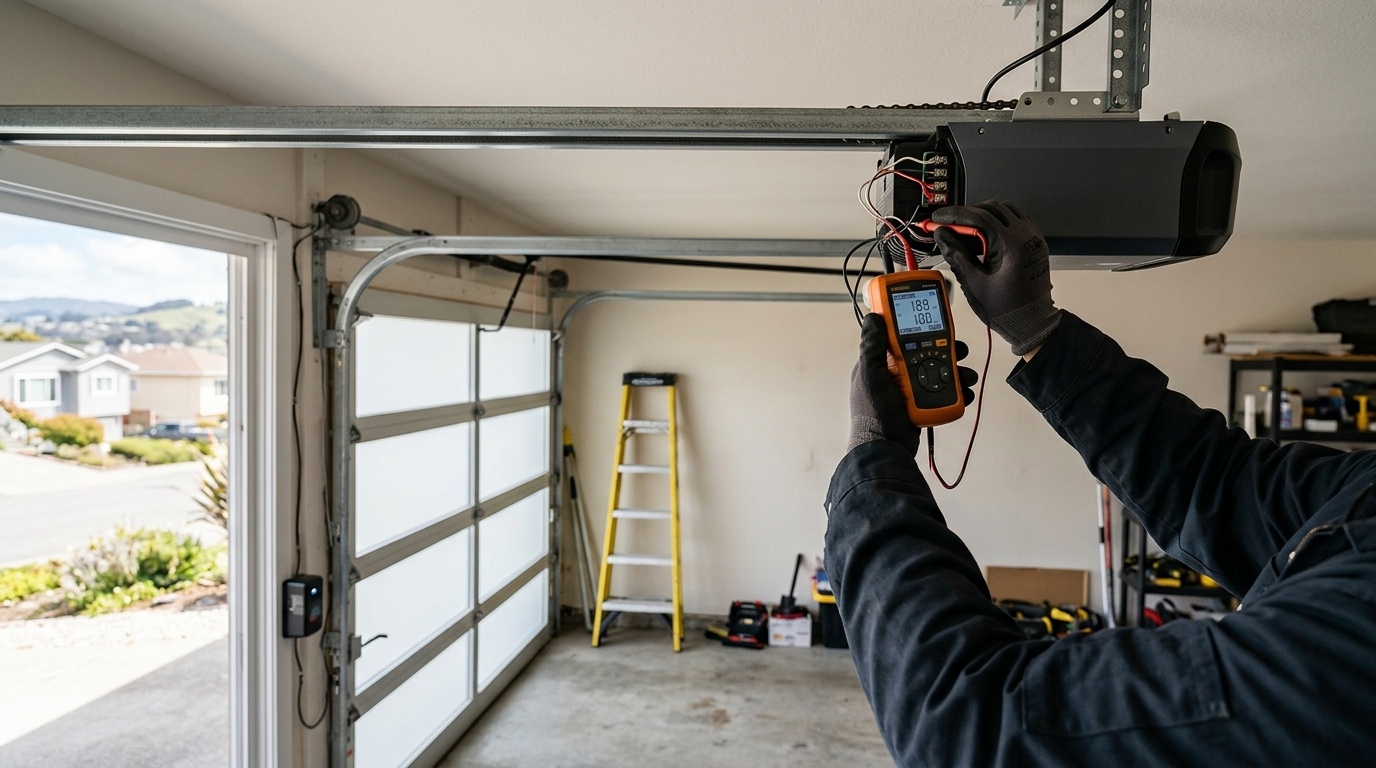
Start with the simple checks
A garage door opener problem can be electrical, mechanical, sensor-related, remote-related, or caused by the door being too heavy for the opener to move. The first useful step is to avoid blaming the motor too quickly. An opener is designed to guide a balanced door; it is not designed to overpower broken springs, jammed rollers, or a crooked track.
Start with the easy checks that do not require touching high-tension parts. Confirm the opener has power, the wall console is unlocked, the remote battery is fresh, and the door path is clear. Look at the photo-eye sensors near the floor. If their indicator lights are off, blinking, blocked, dirty, or pointed away from one another, the opener may reverse even when the motor is healthy.
If the motor runs but the door does not move, the trolley may be disconnected or the door may be too heavy. If the opener hums and stops, the door may be jammed or the motor may be failing. If the door closes partway and reverses, sensor alignment, travel limits, force settings, or track resistance may be involved. Each symptom points to a different inspection path.
- Pause operation when the door is crooked, jammed, heavy, or hanging partly open.
- Describe the door position, access limits, opener response, and visible damage when you call.
- Keep the first conversation focused on symptoms instead of guessing one failed part.
When the door is the real source
Many opener repair calls begin with the opener because that is the part people hear. In practice, the door itself often creates the strain. Worn rollers can make the opener sound rough. Weak springs can make the opener pull too hard. Bent track can make the door bind. A damaged top section can flex every time the motor starts. Fixing the motor alone will not correct those conditions.
Daly City garages can also be compact, sloped, or crowded with storage. That matters because sensors sit low where boxes, trash bins, bikes, and moisture can interfere. Attached garages under living space may make vibration and noise more obvious, so a small roller or rail issue may feel larger than it looks. A good diagnosis listens to the opener, then checks the door.
Do not bypass safety sensors to make the door close. Do not increase force settings repeatedly to overcome resistance. Those settings exist because the opener has limits. If the door needs extra force to move, the safe answer is to find the resistance and correct it.
- Ask for the door, opener, spring, cable, track, and panel condition to be checked as one system.
- Separate required repair items from optional improvements so the scope stays clear.
- Use photos only when they can be taken safely from the floor.
What to tell the scheduler
When you call (650) 517-6577, describe the opener brand if visible, the approximate age, whether the wall button works, whether remotes work, and what the door does before stopping. Mention blinking lights, clicking, humming, grinding, or sudden reversals. If you can safely photograph the opener label and the door from inside the garage, those photos may help with parts planning.
The repair may be a sensor alignment, remote programming issue, gear or trolley problem, circuit board failure, rail adjustment, or opener replacement conversation. It may also be a spring, roller, track, or door balance issue that only looked like opener failure. The inspection should explain which one is happening before work begins.
The point of troubleshooting is not to turn the homeowner into a technician. It is to avoid unnecessary panic, prevent unsafe force, and make the first conversation more accurate. If the opener problem is simple, the call can move faster. If it is connected to the door system, everyone starts with better information.
- Stop troubleshooting if the opener strains, cables look loose, or spring hardware looks separated.
- Limit DIY checks to power, wall lock, remote battery, sensor obstruction, and visible path blockage.
- Choose a service call when simple checks do not explain the symptom.
Decision points for a safer service call
A good garage door service call starts with clear boundaries. The caller does not need to know every part name, but the caller should know whether the door is open, closed, crooked, noisy, heavy, or reversing. Those details are more useful than guessing a diagnosis. A spring, opener, cable, roller, hinge, panel, or sensor issue can all create overlapping symptoms, and forcing one answer too early can hide the real repair.
For Daly City properties, access matters too. A vehicle trapped in a garage under living space is different from a detached door used for storage. A compact driveway gives less staging room than a wider flat driveway. A door that opens directly near a sidewalk or shared lane may need extra caution while it is stuck. Mentioning those details during the call helps the service conversation stay practical.
The safest pattern is to stop using the opener when the door behaves unevenly. Repeated opener cycles can bend top sections, pull brackets loose, worsen cable wrap, or make a minor alignment issue harder to repair. If the door moves normally after a simple sensor or power check, that is useful too. The point is to separate low-risk checks from forceful work on loaded parts.
What the technician should verify
The inspection should not look at one part in isolation. A spring repair should still include cable, drum, bearing, roller, hinge, and opener observations. An opener repair should still include door balance and track resistance. A panel repair should still consider whether the door remains square and whether the opener has been pulling against damage. The parts work together, so the diagnosis should explain the system.
Clear explanations protect the customer from both under-repair and over-repair. Under-repair happens when the visible failed part is replaced but the cause remains. Over-repair happens when a door that still has service life gets pushed toward replacement without a fair explanation. The middle ground is a written or verbal scope that names the observed problem, the recommended next step, and any optional items that can wait.
This site keeps that same discipline in the content. It does not claim a public storefront address, a review total, a fixed arrival window, or a universal price when those facts are not verified on the page. The service promise is narrower and more useful: call (650) 517-6577, describe the safe facts, and use the inspection to decide whether repair, maintenance, or replacement is the right move.
When to stop troubleshooting
Stop troubleshooting when the door is crooked, hanging, unusually heavy, stuck halfway, making a sharp pop, or showing loose cables. Stop when the opener strains against resistance. Stop when the bottom bracket, spring shaft, cable drum, or center bearing area looks wrong. Those are not good places for trial and error.
Continue only with simple, low-risk checks: power, remote battery, wall lock, sensor obstruction, and visible door-path blockage. If those do not explain the issue, the next step is a call. A calm stop is often cheaper and safer than one more forced opener cycle.
Opener notes specific to attached garages
Many Daly City garages are attached to the home, so opener noise and vibration matter more than they might in a detached structure. A chain drive that is technically working can still be a poor fit if the rail shakes, the door is heavy, or the opener force has been raised to compensate for worn rollers. The inspection should separate comfort upgrades from required repairs so the homeowner understands the difference.
Smart opener features should also be discussed in practical terms. App control, battery backup, lighting, and keypad access can be useful, but they do not replace door balance. A new opener installed on a rough, binding, or heavy door may inherit the same problem. That is why the door has to be tested before the motor decision is made.
Related Daly City pages
Garage Door Repair
From Garage Door Opener Troubleshooting Before You Call, use this Garage Door Repair page to review symptoms, safe checks, repair choices, and what to ask before scheduling service. Card 1 keeps the next step specific to that page instead of repeating a stock teaser.
Open pageGarage Door Spring Replacement
From Garage Door Opener Troubleshooting Before You Call, use this Garage Door Spring Replacement page to review spring balance, cable behavior, and when high-tension hardware should be left alone. Card 2 keeps the next step specific to that page instead of repeating a stock teaser.
Open pageGarage Door Opener Repair
From Garage Door Opener Troubleshooting Before You Call, use this Garage Door Opener Repair page to review opener symptoms, sensor checks, motor strain, and door-balance clues. Card 3 keeps the next step specific to that page instead of repeating a stock teaser.
Open pageGarage Door Cable Repair
From Garage Door Opener Troubleshooting Before You Call, use this Garage Door Cable Repair page to review symptoms, safe checks, repair choices, and what to ask before scheduling service. Card 4 keeps the next step specific to that page instead of repeating a stock teaser.
Open pageOff-Track Garage Door Repair
From Garage Door Opener Troubleshooting Before You Call, use this Off-Track Garage Door Repair page to review rough travel, rubbing track, roller wear, and safe movement checks. Card 5 keeps the next step specific to that page instead of repeating a stock teaser.
Open pageGarage Door Panel Replacement
From Garage Door Opener Troubleshooting Before You Call, use this Garage Door Panel Replacement page to review section damage, fit, alignment, and when repair turns into replacement planning. Card 6 keeps the next step specific to that page instead of repeating a stock teaser.
Open page